
30 Self-Care Ideas That Fit Into a Real Schedule
Self-care has a marketing problem: it’s sold as spa days and expensive serums, when the version that actually works looks like drinking water, going outside, and going to bed on time. The thirty ideas below are deliberately unglamorous. Each takes minutes, costs little or nothing, and targets a real mechanism — hydration, movement, light, rest, connection. Build your own routine from the ones that address your actual weak spots.
Think of this as a menu, not a program. Nobody needs all thirty. Most people need five, done consistently.

1. Water and Stretch, First Thing
Before coffee, before phone: a full glass of water and two minutes of stretching. This simple daily habit reverses overnight dehydration and stiffness in under five minutes — the cheapest possible upgrade to how your morning feels.
Keep the glass by the sink tonight. Future-you won’t have to think.

2. Three Slow Breaths (Seriously, Just Three)
In for four counts, out for six, three times. That’s thirty seconds, and it measurably downshifts your nervous system. Use it before hard conversations, after bad news, in traffic. The barrier is so low there’s no excuse — which is the point.
Longer sessions help, but the three-breath version is the one you’ll actually do daily.

3. One Phone-Free Hour
Pick an hour — dinner, the first hour after work, the last before bed — and put the phone in another room. The constant low-grade vigilance of notifications is a stressor most people have simply normalized. An hour off reminds your brain what baseline calm feels like.
Tell people you’re doing it so nobody panics. Then enjoy the quiet.

4. A Skincare Routine You Can Sustain
Cleanse, moisturize, sunscreen. That’s the whole evidence-based routine — everything beyond it is preference. Done daily, even this minimal version improves skin steadily, and the two minutes of deliberate self-attention genuinely change how you feel walking out the door.
Fold it into your morning routine or evening wind-down, wherever it will actually survive.

5. Journal for Five Minutes
Three lines: what’s on your mind, what matters today, one thing you’re grateful for. Externalizing mental clutter onto paper frees working memory and surfaces patterns — the recurring worry, the draining obligation — that thinking alone never quite catches.
A cheap notebook beats a beautiful journal you’ll be afraid to write in.

6. A Short Daily Walk
Ten to fifteen minutes outside, no destination required. Walking is the rare activity that improves mood, creativity, digestion, and sleep simultaneously — and it’s free. Rain or shine; the bad-weather walks build the habit fastest.
No headphones sometimes. Let your mind wander; that’s where the clarity comes from.

7. An Evening Wind-Down Ritual
Your brain needs a landing sequence: dim lights, no screens, something analog — reading, stretching, tea. Thirty to sixty minutes of deliberate deceleration dramatically improves how fast you fall asleep and how deep that sleep goes.
Start the wind-down at the same time nightly. The consistency is the mechanism.

8. A Weekly Reset Hour
Once a week — Sunday works for most — spend an hour on maintenance: tidy the space, plan the week, review finances, prep one thing. It prevents the slow accumulation of small chaos that becomes overwhelming by Thursday.
Put it on the calendar like an appointment. Unscheduled resets don’t happen.

9. Name Three Good Things
Each evening, write down three specific good things from the day — not ‘family’ but ‘the text my sister sent at lunch.’ Specificity is what makes gratitude practice work; vague gratitude is just positive thinking with extra steps.
On bad days this feels forced. Do it anyway — those are the days it matters most.

10. A Real At-Home Pamper Session
A hot bath, a face mask, fresh sheets, an hour with zero obligations. Not as maintenance — as a deliberate pleasure, scheduled monthly. The ‘I deserve this’ framing isn’t indulgent; it’s how you teach your nervous system that rest is allowed.
Put your phone on Do Not Disturb. A pamper session with notifications isn’t one.

11. Morning Sunlight
Ten minutes of daylight before 10 AM sets your circadian clock, improves nighttime sleep, and lifts mood — more reliably than most supplements. Combine it with the walk from #6 and you’ve stacked two habits into one outing.
Overcast counts. Cloudy daylight is still far brighter than indoor light.

12. Prep Food Before the Week Starts
Ninety minutes on Sunday — grains, proteins, chopped vegetables — and weekday eating assembles itself. Decision fatigue is the enemy of healthy eating; prepped components remove the 6 PM ‘what’s for dinner’ crisis that ends in takeout.
Start with lunches only. Five good lunches change a whole workweek.

13. Declutter One Small Area
Not the whole house — one drawer, one shelf, one countertop. Fifteen minutes, a trash bag, done. Visual clutter is ambient stress; each cleared surface is a small but real reduction in background noise.
Take a before photo. The visible progress is weirdly motivating.

14. Actually Drink Enough Water
Most people run mildly dehydrated: headaches, afternoon slumps, false hunger. A marked water bottle or a simple tally makes intake visible, and visible gets done. Aim for pale-yellow urine — that’s the whole test.
Front-load it: a big glass at each meal plus one mid-morning and mid-afternoon.

15. Read for Pleasure, Not Productivity
Twenty pages of something you enjoy — fiction counts, gloriously — before bed or with morning coffee. Reading slows your breathing, builds focus, and is the rare leisure activity that leaves you more energized than it found you.
Keep the book where the phone used to be. Environment design beats willpower.

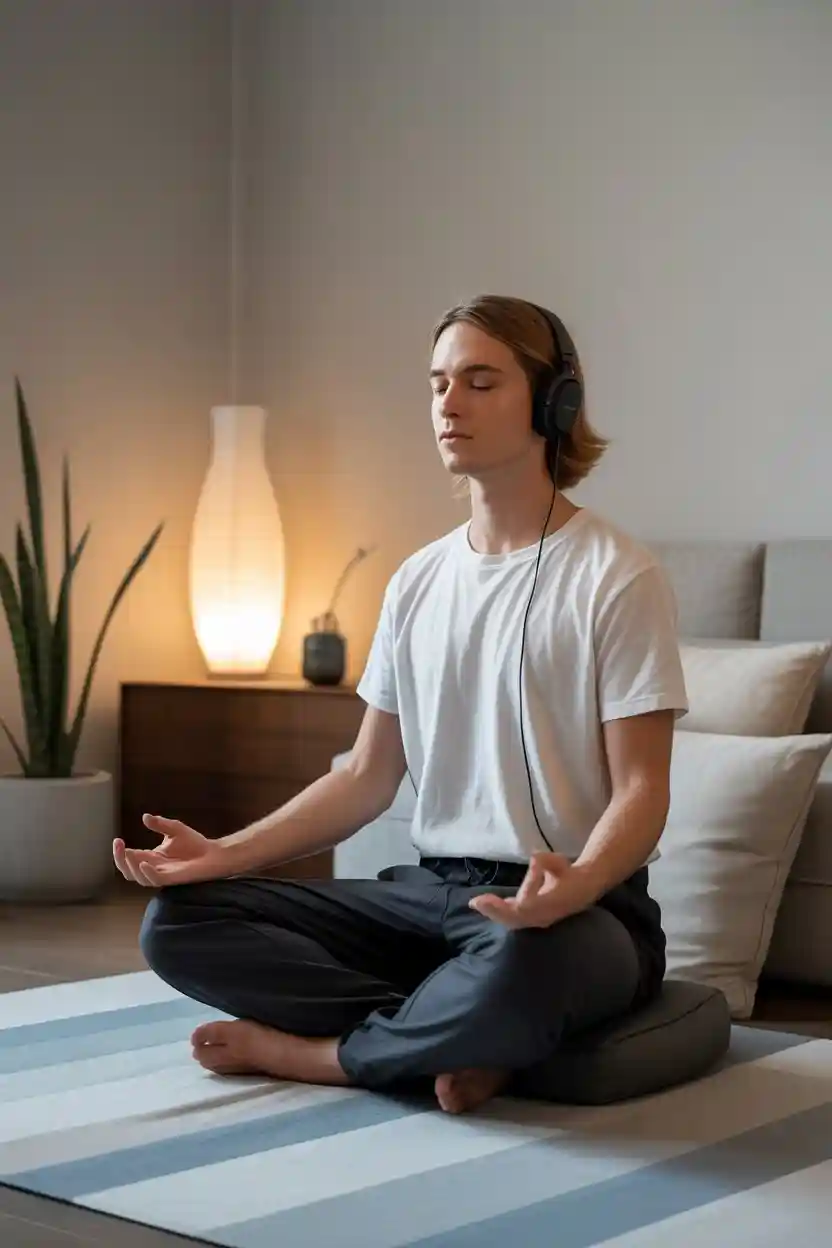
16. Try a Guided Meditation
If silent meditation feels impossible, guided sessions do the steering for you — ten minutes with an app, eyes closed, following the voice. The research on stress and focus is solid; the main obstacle is just starting.
Mornings work best for consistency, but the best time is the time you’ll repeat.
17. Move Your Body Most Days
Not ‘work out’ — move. Walk, dance, lift, swim, garden. Thirty minutes most days, at whatever intensity you can sustain. The mental-health returns arrive within weeks; the physical ones compound for decades.
Schedule it like a meeting. ‘When I feel like it’ is not a schedule.

18. Review Your Day in Two Minutes
Before bed: what went well, what would I change, what’s tomorrow’s priority. Not rumination — a quick debrief. Over weeks, this builds the self-awareness that prevents repeating the same stressful patterns.
Write it down. Mental reviews evaporate; written ones accumulate.

19. Use Music Deliberately
Build playlists for states, not just tastes: a focus mix, a wind-down mix, a get-moving mix. Music reliably shifts mood and energy — it’s one of the fastest emotional levers you have, and it asks nothing of you.
The wind-down playlist, played nightly, becomes a sleep cue within weeks.

20. Keep a Hobby That’s Just Yours
Drawing, baking, woodworking, language apps — something with no audience and no income goal. Creative play is genuine restoration, and it protects a part of your identity that isn’t ’employee’ or ‘parent.’ It’s a
healthy break from routine that pays back in resilience.21. Protect Your Sleep Like It Matters (It Does)

21. Protect Your Sleep Like It Matters (It Does)
Consistent bedtime, cool dark room, no screens for the last hour, no caffeine after noon. Sleep hygiene sounds boring because it is — and it’s also the highest-leverage health habit in existence. Everything on this list works better on good sleep.
If you fix one thing this month, fix the bedtime.

22. Practice One Honest Affirmation
Skip the mirror pep talks that make you cringe. Instead: one true sentence about a strength you actually have, repeated when doubt shows up. ‘I’ve handled hard things before’ beats ‘I am a limitless success magnet’ because your brain believes the first one.
Believability is the active ingredient. Write your own.

23. Call Someone You Like
Not a group chat — a voice, a face, a coffee. Meaningful connection is as predictive of longevity as exercise, and loneliness is a genuine health risk. Ten minutes with a friend does more for your mood than an hour of scrolling past their photos.
Schedule recurring catch-ups. Friendships run on calendars, not intentions.

24. Get Outside Daily
Beyond the walk: sit in a park, eat lunch on a bench, garden, hike on weekends. Nature exposure lowers cortisol and restores attention in ways indoor rest doesn’t quite match. Even twenty minutes counts.
Leave the headphones behind at least sometimes. The soundscape is part of it.

25. Set One Clear Goal
Vague aspirations (‘get healthier’) die quietly. One specific, measurable goal — ‘walk 8,000 steps daily this month’ — gives your efforts direction and your brain a win to register. Review weekly, adjust monthly.
Write it where you’ll see it daily. Out of sight is out of mind, literally.

26. Look at Your Money Weekly
Financial stress is health stress. Fifteen minutes a week: check balances, review spending, confirm bills are handled. Awareness alone reduces money anxiety dramatically — most financial dread is about the unknown, not the numbers.
Automate savings first, then budget what’s left. Pay yourself before the bills.

27. Learn Something Small Regularly
Fifteen minutes a day on a skill — a language app, a cooking technique, an instrument — keeps your brain plastic and your confidence growing. The subject matters less than the feeling of progress, which is its own kind of care.
Pick the thing you’ve been ‘meaning to’ for years. Start embarrassingly small.

28. Say No Once This Week
Boundaries are self-care with teeth. Decline one thing you’d normally accept out of guilt — the extra project, the draining favor, the event you dread. Each no protects energy for the yeses that matter.
‘Let me think about it’ buys you the space to decide honestly.

29. Tidy Your Digital Space
An overflowing inbox and 47 open tabs are ambient stress. Spend twenty minutes weekly: archive ruthlessly, close tabs, delete unused apps. Digital clutter taxes attention exactly like physical clutter does.
Unsubscribe from five mailing lists right now. Future-you says thanks.

30. Celebrate the Small Wins
Finished the week of walks? Note it. Kept the bedtime? Acknowledge it. Progress you don’t register doesn’t motivate — and motivation is what carries habits through the boring middle weeks. The reward can be tiny; the recognition is the point.
Keep a simple log. Watching the streak grow is its own reward.

FAQs for self-care ideas