What Is Overlay Mosaic Crochet (And Why Everyone Is Hooking It)
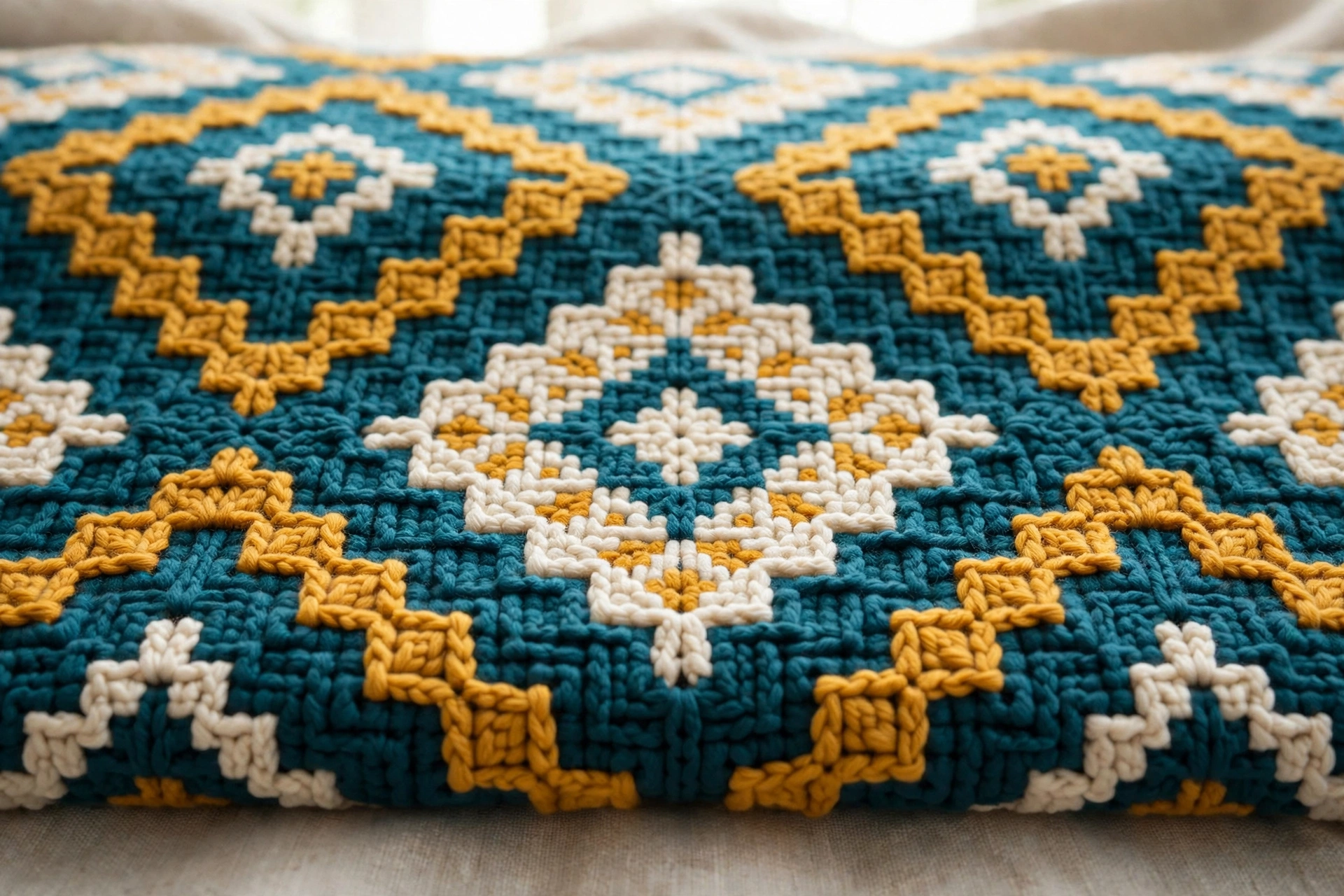
If you have spent any time on crochet social media lately, you have seen them: bold, graphic blankets that look almost painted, with crisp diamonds, sweeping Aztec bands, and flowers that pop off the fabric. That is overlay mosaic crochet, and it has earned its moment for one simple reason — it gives you the look of complicated stranded colorwork while only ever handling one color at a time.
The technique is beautifully straightforward. You work in single crochet through the back loop only, and every so often you drop a tall double crochet down into the front loop of the stitch two rows below. Because you change color at the end of every row — never mid-row — there are no bobbins, no tangles, and almost no ends to weave in. The dropped stitches sit proudly on the surface, which is where the “overlay” name comes from, giving the fabric a rich, textured relief you can feel under your fingers.
Below you will find sixteen motif ideas that show off what the technique can do, from beginner-friendly geometrics to showpiece medallions. Free charts for all of these styles circulate widely in the mosaic crochet community — search the motif name plus “mosaic chart” and you will find plenty to download — plus a full walkthrough on reading those charts, my best practical tips, and answers to the questions I hear most.
1. Classic Diamond Lattice
The little black dress of mosaic crochet. A simple grid of interlocking diamonds that looks far more impressive than it is — the entire chart is one small repeat, so once you have memorized it, you can crochet on autopilot. This is the motif I hand to every mosaic beginner because it teaches the rhythm of the technique without any fiddly counting. Try it in navy and warm cream for a timeless look, or go bold with black and mustard for a mid-century vibe. The geometry suits a full-size throw blanket beautifully, but it also makes a striking cushion front. Difficulty: beginner. It works up fast in a worsted-weight acrylic, and the repeat is forgiving if your tension wobbles while you are learning.
2. Aztec Sunset Bands
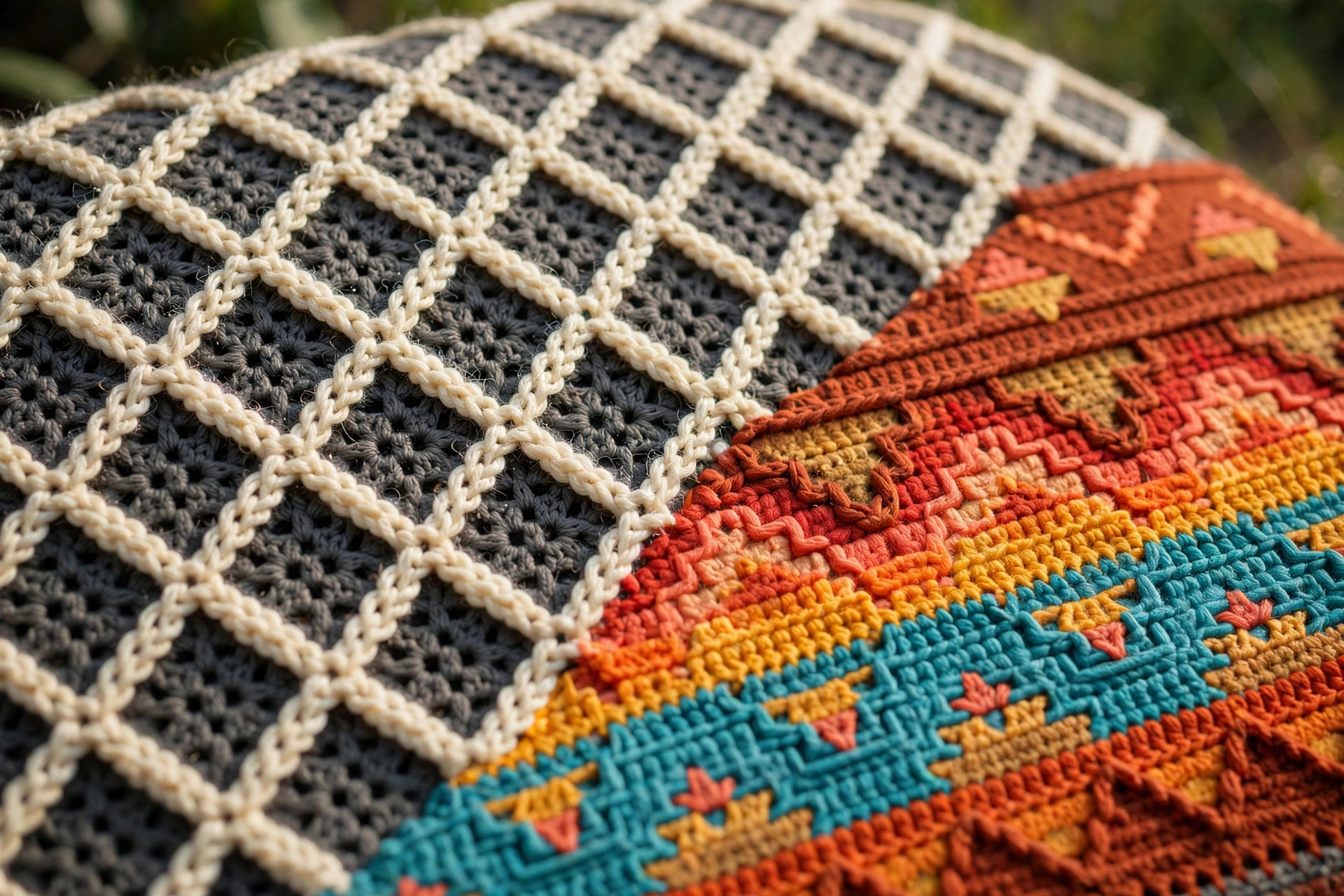
Horizontal bands of stepped triangles and zigzags in sunset colors — terracotta, rust, dusty rose, sand, and charcoal — give this design its desert-at-dusk drama. The chart looks busy, but it is really just stacked rows of simple repeats, so it is very manageable once you stop being intimidated by it. The trick is color order: place your darkest shade in the middle bands and let the colors glow outward toward the edges. This one begs to become a wall hanging or a statement tote bag, where the horizontal stripes can really shine. Difficulty: confident beginner to intermediate. Keep a row counter handy, because the band sequence matters more here than in an all-over repeat.
3. Greek Key Border
That meandering squared spiral you see on classical architecture translates to mosaic crochet almost perfectly, because it is built from straight lines and right angles — exactly what mosaic charts do best. Most crocheters use it as a border rather than an all-over fabric: work a plain or lightly textured center, then let the Greek key run around all four sides like a frame. White on deep Aegean blue is the classic pairing, but black and gold feels wonderfully Art Deco. It is made for table runners, where the border gets admired up close, and for giving a simple blanket a tailored, expensive finish. Difficulty: intermediate, mostly because turning the corner neatly takes a little planning.
4. Blooming Floral Medallion
Proof that mosaic crochet is not just angles and geometry. This motif builds a large stylized flower — layered petals radiating from a tight center — usually worked as one big central panel. It is a showpiece: in dusty rose, sage green, and cream it looks like something from a botanical print, and the raised overlay stitches give the petals real dimension. Because the chart is large and non-repeating, you will be reading every row, so pour the tea and settle in. It makes a breathtaking baby blanket center or the front of a special cushion. Difficulty: intermediate to advanced. Stitch markers at the chart’s quarter points will save your sanity.
5. Cheerful Chevron Waves
Zigzag chevrons are the friendliest entry point into mosaic colorwork, and the wave-like rhythm is genuinely soothing to crochet — up, down, up, down, row after row. A three-color sequence like teal, white, and coral keeps it lively, while two colors in high contrast looks crisp and modern. Because the repeat is short and the chart is easy to memorize, this is a wonderful travel or television project. It is a natural baby blanket: soft, cheerful, and quick, and the zigzags hide minor tension inconsistencies beautifully. Difficulty: beginner. If you can single crochet and double crochet, you can make this on your first mosaic attempt.
6. Southwestern Zigzag
Think desert blankets and roadside trading posts: bold stepped diamonds and lightning zigzags in turquoise, burnt orange, cream, and chocolate brown. This style looks spectacular at large scale, so plan generous — a full throw lets the big motifs breathe. The colorwork does all the talking, which means your stitching can be simple and your yarn can be humble; an affordable acrylic in the right palette will look like a million dollars. It drapes beautifully as a poncho or a couch throw. Difficulty: beginner to intermediate. The only real skill is choosing colors with enough contrast — hold your skeins together at arm’s length and squint; if they blur together, swap one out.
7. Celtic Knotwork
Interlacing bands that weave over and under each other, drawn entirely in straight mosaic stitches — it should not work, but it absolutely does. The illusion of woven ribbons comes from careful chart design, and the result looks like carved stone or illuminated manuscripts. A deep forest green on natural undyed wool is my favorite pairing; it feels ancient and precious. This is slow, deliberate crochet: the charts are intricate and there is no shame in using a magnetic board or highlighter to track your row. It makes a magnificent masculine-leaning throw or a gift blanket with real gravitas. Difficulty: advanced. Not because the stitches are hard, but because the chart demands your full attention.
8. Bohemian Rainbow Arches
Soft, nested arches stacked in a muted rainbow — sage, clay, ochre, dusty blue — on a warm cream background. This is the nursery blanket of dreams, and it is far easier than it looks: each arch is just a curved staircase of dropped stitches, and the whole chart is one tidy repeat. The muted palette is what makes it feel modern rather than cartoonish, so resist the urge to reach for primaries. Beyond nurseries, it makes a lovely lumbar pillow or the back panel of a cardigan. Difficulty: beginner. It is also a brilliant stash-buster, since each arch can be a different leftover, as long as the background color stays constant.
9. Honeycomb Hexagons
Repeating hexagons in honey gold and warm charcoal have a cozy, beehive warmth that suits autumn projects perfectly. The hexagon is a slightly trickier shape in mosaic than squares and diamonds, because the chart has to step the edges diagonally — but the available free charts have already solved that geometry for you, so you just follow along. I love this one in cotton for sturdy, washable pieces: market bags, cushion covers, and placemats where the dense mosaic fabric is a genuine advantage. Difficulty: intermediate. Cotton has less give than acrylic, so keep your dropped stitches relaxed or the hexagons will pucker.

10. Starry Night Sky
Scattered eight-pointed stars on a deep midnight blue, with the stars picked out in soft gold or cream — it looks like the sky over the desert, and it is pure magic as a child’s blanket. The chart alternates large feature stars with tiny filler motifs, which keeps the crocheting interesting without ever getting complicated. For extra wonder, work the stars in a yarn with a subtle metallic thread or a soft halo; just keep the background yarn smooth and matte so the stars stay the heroes. It also makes gorgeous framed wall art when worked small and blocked hard. Difficulty: intermediate. Counting the space between stars is the fiddliest part.
11. Sweetheart Hearts
Rows of plump little hearts, usually in red and blush pink on cream — the Valentine’s Day classic, and one of the sweetest first mosaic projects you can choose. The heart motif is compact, the chart repeat is tiny, and mistakes are nearly invisible in such a busy little shape. It is a fast make, which matters when you are crocheting to a February deadline. Beyond Valentine’s gifts, it is adorable as a baby girl blanket, a cushion for a reading nook, or a wedding gift when worked in the couple’s colors. Difficulty: beginner. This is the pattern I suggest when someone says they want to try mosaic “just to see” — an hour in, they are hooked.
12. Tropical Pineapple Motif
The pineapple — that old symbol of welcome — gets a fresh, graphic treatment in mosaic, with its spiky crown and crosshatched body translating beautifully to charted stitches. Work it in juicy brights: pineapple yellow, leaf green, and hot coral on white, and you can practically feel the sunshine. The motif is usually charted as a standalone block, so it is perfect for a summer tote bag, a beach bag, or a market bag where one big motif per side is exactly right. It also makes a cheerful cushion for a sunroom. Difficulty: intermediate. The crown’s points need accurate stitch placement, so count carefully through that section.

13. Modern Minimalist Lines
Not every mosaic has to shout. Thin offset lines, broken grids, and quiet geometric marks in black on white — or warm beige on cream — give you a Scandinavian-calm fabric that fits contemporary interiors. This is mosaic at its most meditative: long, simple rows with minimal counting, and the high-contrast monochrome palette means every stitch reads crisply. It makes an elegant throw for a minimalist living room, and it is one of the few crochet blankets that looks at home in a very modern space. Difficulty: beginner. The simplicity is deceptive in the best way — guests will assume it took far more skill than it did.
14. Mandala Rounds
Most mosaic is worked in rows, but mandala-style medallions worked in the round are a whole sub-art: concentric rings of petals, points, and lace-like geometry blooming outward from the center. Jewel tones — emerald, sapphire, ruby, amethyst — on a dark background create stained-glass drama. These are slow, glorious projects; a large round mandala can become a rug, a wall hanging, or the centerpiece of a blanket surrounded by a plain border. Difficulty: advanced. Working mosaic in the round changes how you read the chart, and increases are hidden in the design, so follow a well-tested chart rather than improvising.
15. Art Deco Fans
Sweeping scallop fans in emerald, gold, and black channel 1920s glamour — think Great Gatsby in crochet form. The fan shape shows off the overlay texture beautifully, because the curved rows of dropped stitches catch the light like pleats. This is a special-occasion motif: an evening clutch, a cushion for a glam bedroom, or a dramatic table runner for holiday entertaining. Keep the palette tight — two or three colors maximum — because Deco is all about discipline and shine. Difficulty: intermediate. The curves are an illusion built from stepped stitches, so trust the chart even when a row looks wrong; it resolves a few rows later.

16. Woodland Falling Leaves
Scattered oak and maple leaves in russet, amber, olive, and bark brown make the definitive autumn throw. Each leaf is a small self-contained motif, so the chart reads as a pleasing scatter rather than a rigid grid, and you can easily adjust the spacing to make the fabric denser or airier. I like this in a wool blend for extra warmth and that rustic, cabin-weekend feel. It is wonderful as a seasonal throw across the foot of a bed, or as a table runner for Thanksgiving. Difficulty: intermediate. The leaves lean diagonally, so keep your fabric flat as you go and let blocking do the final straightening.
How to Read Mosaic Charts
Mosaic charts look cryptic for about ten minutes, and then they click forever. Here is the whole system. The chart is a grid where each square represents one stitch, and each row of the grid is one row of crochet. Rows are numbered up the side — odd rows are usually the right side, even rows the wrong side. You read right-side rows from right to left, exactly the direction your hook travels.
There are only two symbols to learn. A blank square means: single crochet in the back loop only of the next stitch. A marked square — usually shown as a filled square or an X — means: double crochet in the front loop of the stitch two rows below (the same color row), which drops down and covers the stitches in between. That is genuinely the entire stitch vocabulary.
A few chart conventions make life easier. You work one color per row and switch color at the end of every single row — the chart’s row colors tell you which yarn to pick up. The first and last stitch of every row are worked as a normal single crochet through both loops; this creates a neat selvedge edge. Repeating sections are marked with brackets or arrows — you work the section between the markers as many times as the pattern says, then finish the edge stitches. Most charts also include a small setup row or two; do not skip these, as they establish the foundation the dropped stitches anchor into. And here is the golden rule: trust the chart over your eyes. Mosaic often looks wrong for several rows before the motif suddenly resolves — keep going.
Tips for Beautiful Mosaic Crochet
- Choose yarns of the same weight with strong contrast. Mosaic lives or dies on contrast — two colors that look distinct in the skein can blur together in the fabric. Photograph your yarn choices in black and white; if they turn the same gray, pick again.
- Go up half a millimeter in hook size. The dropped double crochets pull the fabric slightly tighter than plain single crochet, so a 5.5 mm hook where you would normally use 5 mm keeps the fabric supple instead of stiff.
- Keep your dropped stitches tall and relaxed. The most common beginner mistake is yanking the long double crochets tight, which puckers the fabric. Let them stand proud — that raised texture is the whole point of the overlay style.
- Use smooth, plied yarns rather than fluffy or novelty yarns. The crisp stitch definition of a smooth acrylic, cotton, or wool is what makes the geometric motifs pop; fuzzy yarns blur the chart’s clean lines.
- Hide your ends with an envelope border. Since you cut the yarn at the end of every row, you will have a fringe of ends along both edges — sandwich them between the blanket and a simple single-crochet border worked around all four sides, and they vanish completely with zero weaving.
- Block your finished piece. Mosaic fabric tends to cup and curl off the hook; a good steam block or wet block relaxes the stitches, evens the tension, and makes the geometric motifs lie perfectly flat.
- Mark your chart repeats with stitch markers in the work. Placing a marker at each repeat boundary lets you catch a counting error within one repeat instead of discovering it ten rows later.
Frequently Asked Questions
Is overlay mosaic crochet hard for beginners?
Honestly, no — and that is why it has exploded in popularity. If you can single crochet and double crochet, you already know every stitch involved. The learning curve is reading the chart, not working the stitches, and most beginners find the chart clicks after the first pattern repeat. Start with a small project like the chevron waves or sweetheart hearts above before committing to a blanket.
What is the difference between overlay and inset mosaic crochet?
In overlay mosaic, you work one color per row, cut the yarn at the end of every row, and the pattern stitches sit raised on the fabric’s surface. In inset mosaic, both yarns stay attached and you work back along the row with the second color, so nothing is ever cut and the fabric stays flat. Overlay is more popular because its charts are simpler to read and the textured finish is so distinctive; inset appeals to crocheters who hate weaving ends.
Can I convert a knitting fair isle chart to mosaic crochet?
Often, yes — geometric fair isle charts adapt beautifully, since both crafts work from the same kind of grid. Each square becomes one mosaic stitch. The limitation is color: mosaic uses exactly one color per row, so choose charts where no single row needs more than two colors total. Simple two-color geometrics, stars, and hearts convert best; complex multi-color scenes do not.
Why does my mosaic crochet curl, and how much yarn do I need?
Some curling is completely normal — the tall dropped stitches pull the fabric, and it relaxes with blocking and an envelope border, so do not panic mid-project. For yarn quantities, mosaic is thirstier than plain crochet because of those long stitches; budget roughly a third more yarn than you would for the same size in single crochet. When in doubt, buy the extra skein — dye lots matter more than the small saving.
Pick Your Chart and Cast On
Overlay mosaic crochet is one of those rare techniques that looks far harder than it is, which makes it pure joy to learn and even purer joy to gift. Choose the motif that made your fingers itch while reading — the beginner-friendly chevrons or hearts if you are new, the Celtic knotwork or floral medallion if you want a challenge — find a free chart, pick two colors you love, and work the first ten rows. By row eleven, you will be reading charts like a native. Happy hooking.